The Slow Travel Packing Checklist for Countryside Walks in Italy
A good walk in the Italian countryside rarely fails because of the walking. It fails because of a blister from untested boots, a cold wind on an exposed ridge in Le Marche, or a phone that died three kilometres from the car. The fix is not more equipment. It is the right equipment, chosen before you leave and packed into a bag you can carry for four hours without thinking about it.
What follows is a working list, shaped by gravel roads, mule tracks and olive terraces rather than by gear catalogues. Print it, cross out what does not apply to your particular walk, and pack the night before so nothing is decided in a hurry.
Start From the Ground: Shoes and Socks
Italian countryside walking is gentler than alpine hiking but rarely uniform. You will meet strade bianche that turn slippery after rain, stone paths polished by centuries of feet, field edges of tall grass and the occasional stretch of asphalt between villages. A trail shoe with a real tread handles most of it. If your route crosses limestone in the Apennines or gains serious altitude, boots with ankle support are the better bet.
Whatever you choose, walk in it before you travel. Twenty minutes around the block tells you more than a specification sheet. Test the sole on wet stone if you can; that is where cheap rubber shows itself.
Socks matter as much as shoes. Cotton holds moisture against the skin and invites blisters. Merino or a synthetic blend dries faster and stays comfortable. A thin liner sock underneath the main pair reduces friction and is the cheapest blister prevention there is. For trips of three days or more, bring two walking pairs, rinse one each evening and hang it outside.
Add one small pair of light shoes or sandals for evenings. Your walking shoes will be muddy, and agriturismi tend to have clean floors.
Clothing: Three Layers and One Extra
Countryside temperatures can swing fifteen degrees between a shaded morning start and an open, south-facing afternoon. Layers, not a heavier jacket, are how you handle it.
The layers
- Base layer: merino or synthetic shirt. Skip cotton, which stays damp and chills you at the first rest stop.
- Mid layer: a light fleece or thin down jacket that packs to the size of a grapefruit.
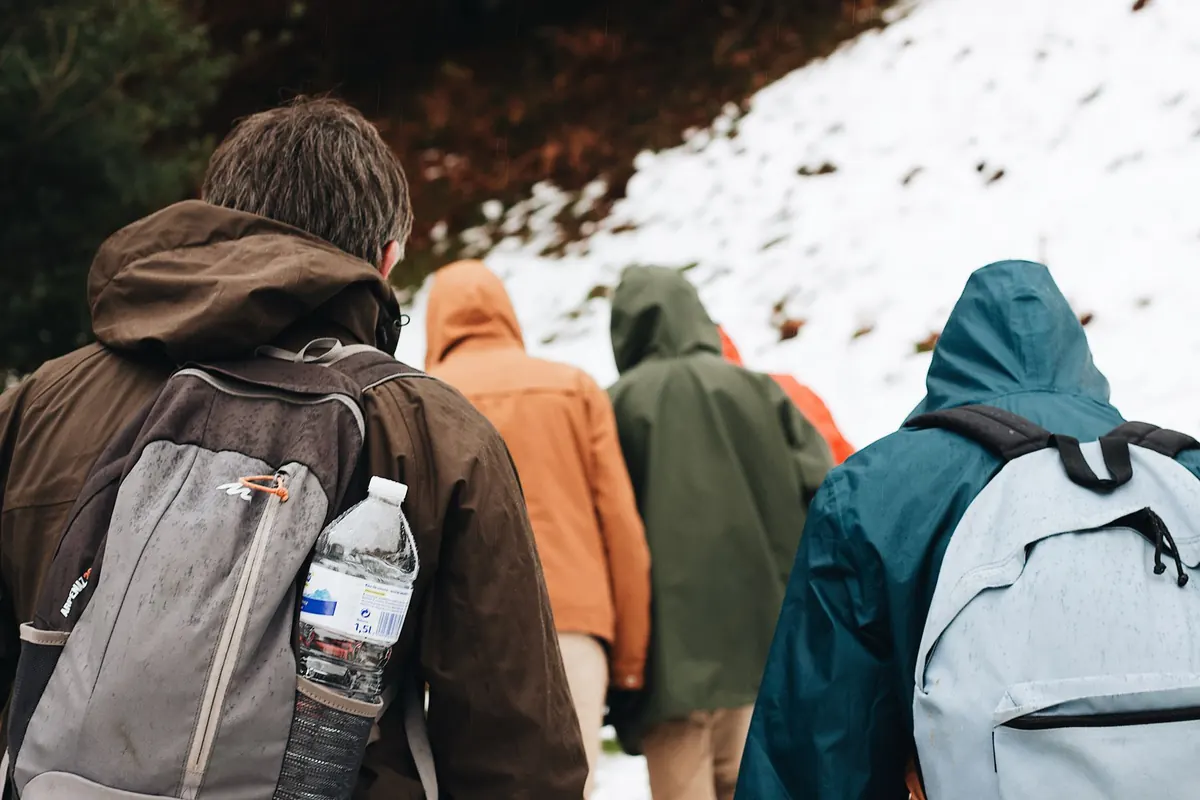
- Shell: a packable waterproof with a hood. A thin rain jacket also blocks wind, which is often the real problem on ridges.
The extra
Carry a light scarf or a long-sleeved shirt in the pack. Many churches and small sanctuaries along rural routes ask for covered shoulders and knees, and a scarf doubles as sun protection or a picnic cloth. In tall grass and scrub, long trousers are more sensible than shorts: they protect against nettles, thorns and ticks. Choose trousers you can roll up when the path opens out.
One more small habit: in autumn, hunting is active in many rural areas. A bright hat or a buff in an unmissable colour costs almost nothing and makes you visible. Stay on marked trails and avoid unofficial shortcuts through fields.
What Earns Its Place in the Daypack
A daypack of 15 to 20 litres is plenty for a full day on foot. Fill it with this and resist the rest:
- Water: one to one and a half litres, in a refillable bottle. Villages and trailheads often have fountains, but check that a non potabile sign is not posted before you fill up.
- Food: bread, cheese, fruit, a handful of nuts. Many trattorie in the countryside keep odd hours or close on quiet weekdays, so never assume lunch is waiting ahead.
- Blister kit: plasters, a small roll of tape, and a tiny pair of scissors. Treat hot spots at the first twinge, not at the end of the day.
- Sun protection: high-factor cream, sunglasses, a brimmed hat. Spring sun on open ground is stronger than it feels.
- Offline map: download the route onto your phone before leaving, and carry a paper printout as backup. Signal disappears in valleys.
- Power bank and a short charging cable.
- Small first-aid items: antiseptic wipes, a few painkillers, any personal medication you use.
- A cloth bag for your own rubbish, and a spare plastic bag for muddy shoes.
- Trekking poles if you have knee trouble on descents. Collapsible ones strap to the outside of the pack.
- A headtorch if your route could run longer than planned. A long lunch can turn a five-hour walk into a six-hour one.
Documents, Money and the Paper Things
Digital is fine until a battery dies. Keep a small zip bag with the essentials:
- Photo ID or passport, plus a photo of it stored on your phone.
- Your European Health Insurance Card if you are travelling from an EU country, and details of any travel insurance.
- Cash in small notes — twenty or thirty euros will cover a coffee, a bus fare or a farm stall that takes no cards.
- A paper card with the address and phone number of your accommodation, written in Italian. Useful if you need to ask directions.
- Printed route notes, and a photograph of the trail sign at the last junction where you turned.
For anything involving insurance cover, medical conditions or medication while abroad, check the details with your insurer or doctor before you travel rather than relying on a checklist.
The Printable Checklist
Worn on the day
- Broken-in shoes with tread
- Merino or synthetic socks, plus liners
- Base layer, mid layer, packable shell
- Long trousers you can roll up
- Hat, sunglasses, sun cream applied
In the pack
- Water bottle, full
- Lunch, snacks, small rubbish bag
- Blister kit and personal medication
- Offline map, paper route notes, power bank
- Scarf for church visits
- Light evening shoes in the main luggage
In the zip bag
- ID, health card, insurance details
- Cash in small notes, one card
- Accommodation address and phone number
What to Leave Behind
The heaviest thing in most packs is the fear of being unprepared. Leave the drone at home: rules on flying over farmland, villages and protected areas vary and are often stricter than visitors expect. Leave the full camera kit if you will be walking all day; a phone and a small compact will earn their keep. Leave the speaker, the hardback guidebook, the second jumper, the heavy toiletries and anything you packed for a "just in case" you cannot actually name.
Leave new boots in the shop. Leave the ambitious itinerary, too. Three villages and a long lunch make a better day than six villages and a rushed sandwich. And leave the umbrella unless you are walking between town centres; a hooded shell is easier on a windy ridge.
Before You Set Off
Run a two-minute check at the door: water full, shoes laced properly, phone charged with the route saved offline, blister plasters somewhere you can reach without unpacking everything. Tell someone at your accommodation roughly where you are going and when you expect to be back. Check the forecast once more, but still take the shell. Then put the checklist away and walk; the point of slow travel is that the day should feel lighter than the bag.
Photo: Maël BALLAND / Pexels